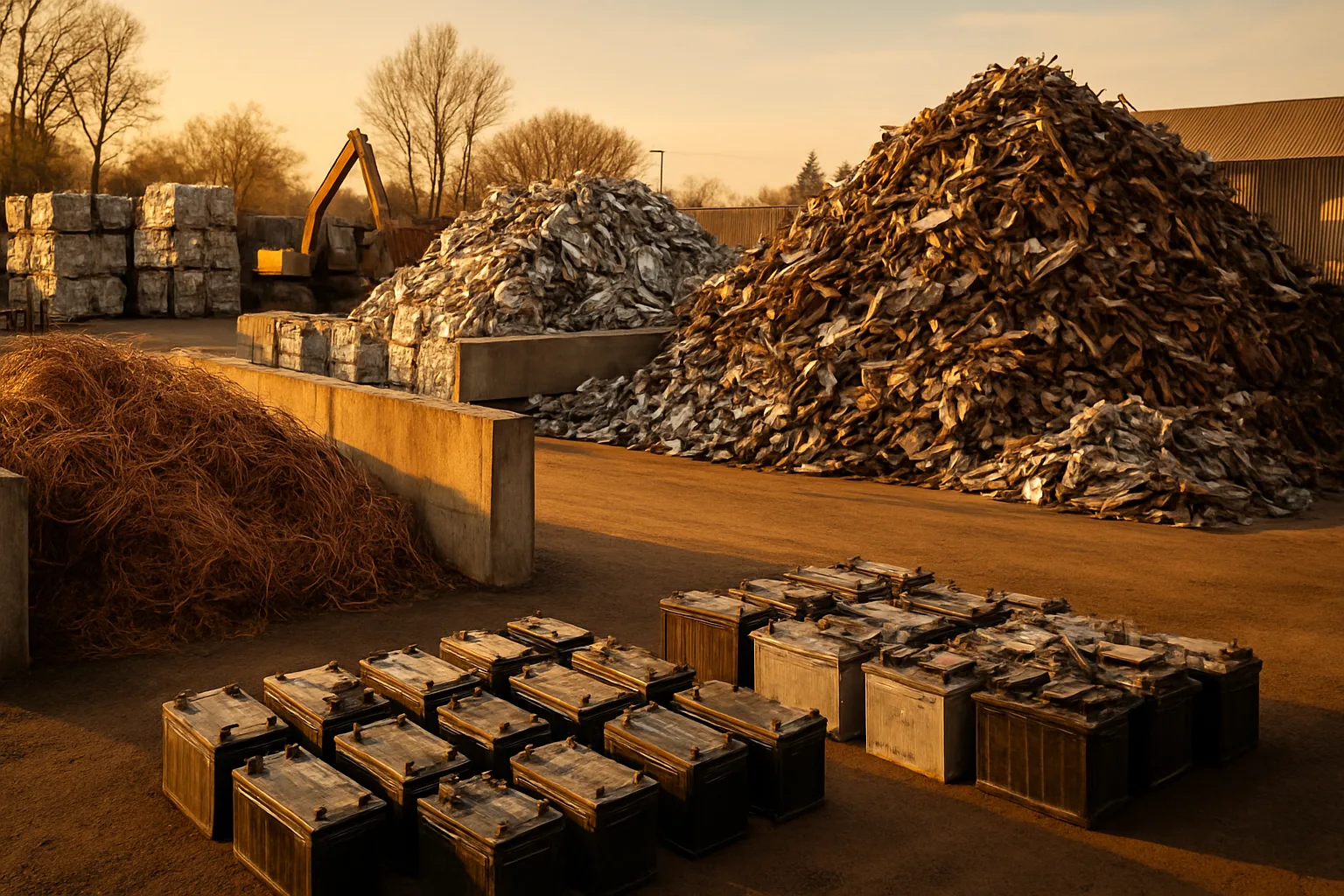
What Your Old Car Batteries Are Actually Worth in 2026
Most people toss old lead-acid batteries in the corner of the garage and forget about them. That's money sitting on a shelf. Lead-acid batteries — the kind in your car, truck, boat, or forklift — contain significant amounts of recoverable lead, and lead scrap has real value in today's market. If you're sitting on a pile of dead batteries in Nanaimo, you're closer to cash than you think.
Lead-acid battery recycling is one of the most mature recycling loops in the entire metals industry. Over 95% of the lead in a spent battery can be recovered and reused. That's not marketing language — that's the chemistry. Recyclers want these batteries. The question is whether you're getting a fair price when you hand them over.
How Lead-Acid Battery Recycling Works — and Why Lead Scrap Has Value
A standard 12-volt automotive battery weighs between 18 and 22 kilograms. Most of that weight is lead — the plates, terminals, and grid structure inside. When a recycler breaks a battery down, they recover lead in two main forms: hard lead (from the plates) and soft lead (from the terminals and connectors). Both have market value.
The lead is smelted, refined, and fed back into new battery manufacturing or other industrial uses. This closed-loop system is why lead recycling rates are so high globally. Recyclers aren't doing this out of goodwill — there's solid economic demand for recovered lead. That demand is what puts money in your pocket when you bring in a load.
- Automotive batteries (12V): Most common type. High volume at most yards.
- Industrial and forklift batteries: Heavier, often 50–100+ kg. Higher payout per unit.
- Marine and deep-cycle batteries: Similar lead content to automotive. Valued similarly.
- UPS and backup power batteries: Common in commercial settings. Often found in larger quantities.
If you're running a shop, fleet operation, or any business that cycles through equipment, you're generating spent batteries on a regular basis. Treating that as scrap — and getting paid for it — is just smart business. Platforms like Canada's B2B scrap recycling marketplace exist specifically to connect sellers with buyers who compete for that material.
Best Scrap Metal Prices in British Columbia — What Affects Your Lead Payout
Lead scrap prices fluctuate based on the London Metal Exchange (LME) price for lead, local supply and demand, and the condition of the material you're bringing in. In British Columbia, pricing at local yards generally tracks LME lead with a local spread applied. That spread — the difference between what the LME says and what you actually get — is where the variability lives.
Several factors directly affect what you'll be paid for lead-acid batteries:
- Battery condition: Intact batteries with no cracks or major acid leaks command better prices. Damaged units may be docked or refused at some yards.
- Volume: A single battery is worth something. Twenty batteries is worth a conversation. Commercial quantities get better per-unit pricing.
- Current LME lead price: Lead trades globally. When LME lead is up, your payout moves up with it.
- Buyer competition: One buyer means one price. Multiple buyers means the market sets the price. That's a fundamental difference.
- Documentation: If you're selling a large lot of industrial batteries, having photos, weight estimates, and a packing list gives buyers more confidence — and confidence translates to better bids.
Disclaimer: Lead scrap prices change daily based on commodity markets. Always verify current rates before finalizing a sale.
If you want the best scrap metal prices in British Columbia, the move is simple: don't rely on a single quote from a single buyer. That's the old way. Get your material in front of multiple vetted buyers and let them compete. That's exactly what SMASH is built to do.
Scrap Metal Recycling in Nanaimo — Lead Batteries and Beyond
Nanaimo scrap metal services cover a wide range of materials, and lead-acid batteries are one of the more consistently valuable items in any load. Whether you're a shop clearing out a year's worth of cores, a fleet manager rotating out equipment batteries, or a homeowner with a dead ATV battery taking up space — there's a market for what you have.
Nanaimo sits in a strong position for scrap logistics. Vancouver Island's industrial base — construction, marine, forestry equipment — generates a steady stream of spent batteries and ferrous and non-ferrous metal. That material doesn't have to sit in a yard at whatever price one local buyer decides to offer. With the right platform, it gets seen by qualified buyers across the region and beyond.
Don't overlook what else might be mixed into a load. A battery pull from a shop often comes with other non-ferrous scrap — copper wiring, aluminum brackets, and occasionally catalytic converter cores. If you're already sorting a load, it pays to identify every recoverable material before you hand it over. Each category has its own pricing, and bundling without itemizing often means leaving money on the table.
Lead Batteries Alongside Copper and Catalytic Converters — Sell Smart, Not Fast
One of the most common mistakes scrap sellers make is treating a mixed load as a single transaction. You have lead batteries, some copper scrap, and maybe a catalytic converter or two — and you take it all to one buyer, get one total number, and call it done. That feels efficient. It's usually not the best outcome.
Copper scrap prices in Nanaimo — like anywhere — are driven by copper grade. Bare bright copper, #1 copper, and #2 copper all price differently. A buyer buying your whole mixed load has every incentive to average down. When you separate and document your material, buyers can price accurately, and accurate pricing tends to be better pricing.
The same logic applies when you want to sell catalytic converters online. Cats contain platinum group metals — platinum, palladium, and rhodium — and their value varies enormously by make, model, and serial number. If you're handing over a converter as part of a bulk load without identifying it properly, you are almost certainly undervaluing it. Serial tracking and VIN lookup tools — features built into platforms like SMASH — exist specifically to solve this problem. Documented inventory gives buyers more confidence, and that confidence shows up in bids.
If you're ready to sell your scrap metal at fair Canadian prices, start by sorting your material and knowing what you have before you start talking to buyers.
How SMASH Helps You Get Paid What Your Lead Scrap Is Worth
The traditional scrap selling process goes like this: call one yard, get one price, decide whether to take it or leave it. If you don't have another number to compare it to, you have no idea if that price is fair. Most sellers just take it. That's the gap SMASH addresses.
SMASH is an auction-format platform that connects sellers with vetted buyers who compete for your material. More buyers bidding on your load means better price discovery — not a guaranteed higher number every time, but a transparent, competitive process that reflects actual market demand. That's a fundamentally different experience than a single phone call to a single yard.
Key features that matter when you're selling lead batteries and mixed scrap:
- Inventory documentation: Photo uploads and weight documentation help buyers understand exactly what they're bidding on.
- VIN lookup and serial tracking: Critical for catalytic converters. Proper identification means proper pricing.
- Vetted buyer network: You're not dealing with unknown buyers. The network is qualified.
- Auto-invoicing: Paperwork is handled. No chasing down BOLs or packing lists manually.
- No subscription fees: You pay nothing until a deal closes. SMASH only wins when you win.
If you're a business generating scrap regularly — batteries, copper, aluminum, cats — this process scales with you. Explore scrap metal selling guides to understand how to prepare your loads for the best possible outcome.
Whether you're in Nanaimo, across British Columbia, or anywhere else in Canada, the market is bigger than your nearest yard. Get a fair price for your scrap today by putting your material in front of buyers who actually compete for it. That's the SMASH model — and it exists because the old way left too much money on the floor.
Frequently Asked Questions
Q: How much is a lead-acid car battery worth as scrap in Nanaimo?
The value of a scrap lead-acid battery depends on its weight, condition, and the current LME lead price. Automotive batteries typically weigh 18–22 kg and the lead content drives the payout. Prices fluctuate daily — contact a local buyer or use a platform like SMASH to get a current competitive quote before selling.
Q: Can I sell lead-acid batteries as part of a mixed scrap load?
Yes, but separating and identifying each material type — batteries, copper, aluminum, catalytic converters — almost always results in a better total payout. Selling everything as one bulk load gives buyers room to average down on each category. Sort your scrap before you sell it.
Q: Is scrap metal recycling in Nanaimo different from the rest of British Columbia?
Pricing tracks LME commodity markets across British Columbia, so the base values are similar province-wide. Local supply, buyer competition, and logistics can create small differences in what you're offered. Having access to a broader buyer network — rather than just local yards — helps ensure you're seeing the actual market rate.
Q: Do I need to drain or clean a lead-acid battery before scrapping it?
Most recyclers accept intact batteries as-is — they're designed to process them safely. Heavily cracked or leaking batteries may be refused or discounted at some yards due to handling and environmental considerations. Keep batteries upright during transport and flag any damage upfront.
Q: What other scrap metals should I bring in alongside lead batteries?
Non-ferrous metals — copper wire, aluminum extrusions, catalytic converters, and stainless steel — are high-value additions to any load. If you're already pulling batteries from equipment, check for copper wiring harnesses and aluminum frames at the same time. Identifying and documenting every material type before selling gives you the strongest negotiating position.
If you've got lead batteries, copper, or catalytic converters sitting around, don't leave that value idle. Sell your scrap metal at fair Canadian prices — request a pickup at sell-scrapmetal.ca and find out what your material is actually worth in today's market.
Stay current on scrap metal market trends and price movements — follow SMASH on LinkedIn for industry updates and insights that help you sell smarter.