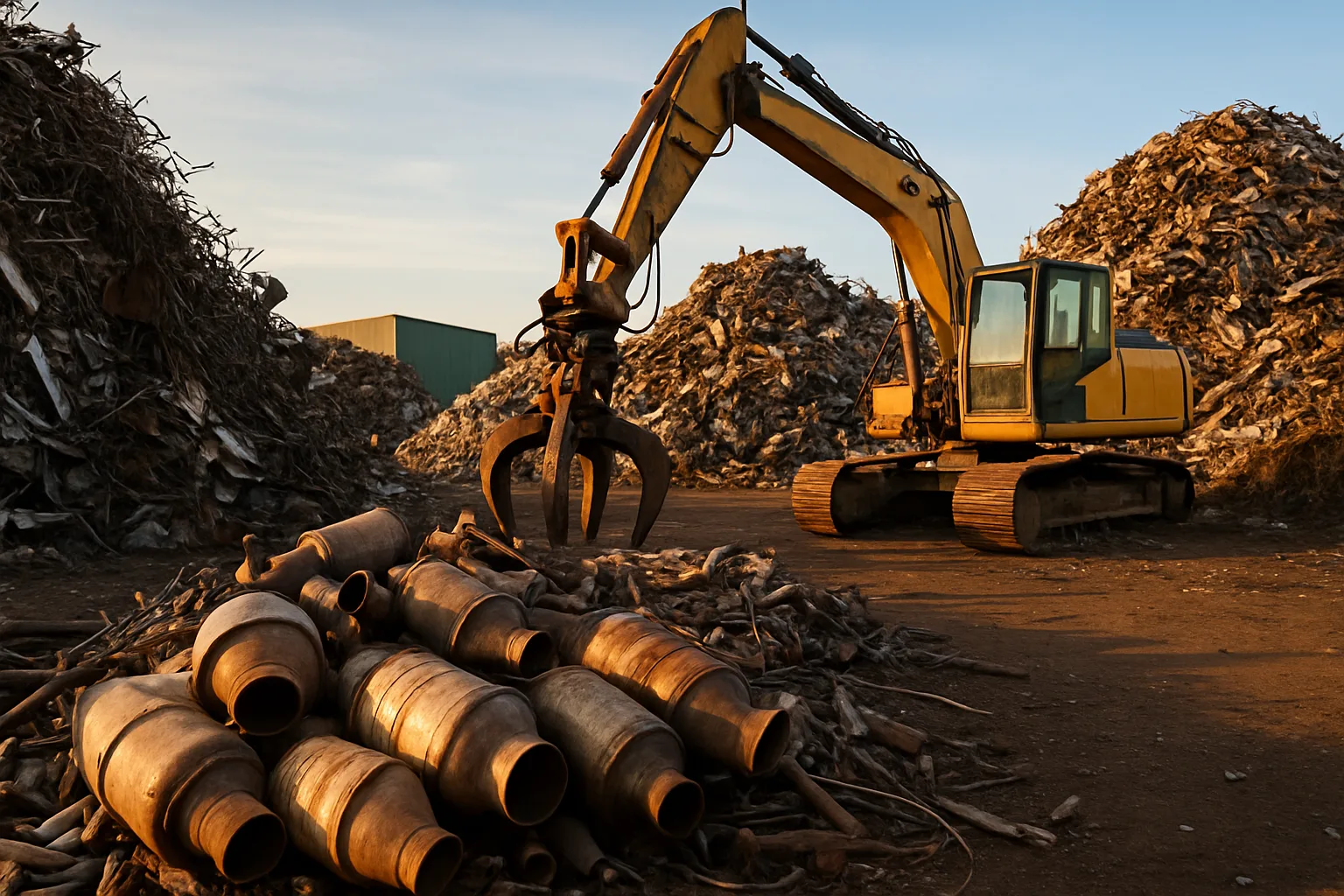
Why Your Catalytic Converter Is Worth More Than You Think — And Why the Price Keeps Changing
Most people pull a catalytic converter off a scrapped vehicle and assume it's worth a flat rate. It isn't. The value swings dramatically based on what's inside — and most sellers never find out why. If you're sitting on a pile of cats in St. John's or anywhere else in Newfoundland and Labrador, understanding how recycling actually works puts real money back in your pocket.
Catalytic converter recycling isn't like selling a bundle of copper pipe or a load of crushed aluminum. The pricing model is more complex, the buyers are more specialized, and the spread between a bad deal and a fair one can be significant. This guide breaks down how the process works, what drives the price, and how platforms like Canada's B2B scrap recycling marketplace are changing the way yards and sellers get paid for their cats.
What's Actually Inside a Catalytic Converter
The reason cats command serious money comes down to three metals: platinum, palladium, and rhodium — collectively known as platinum group metals, or PGMs. These metals act as catalysts inside the converter, breaking down harmful exhaust gases before they leave the tailpipe. They're rare, they're expensive to mine, and recycling is the most efficient way to recover them.
Here's what makes pricing complicated: every converter is different. The amount of PGM loaded into a converter depends on the vehicle make, the model year, the engine size, and the original equipment manufacturer. A cat from a late-model foreign vehicle might contain significantly more palladium than one from a domestic half-ton truck. A diesel-specific converter carries a different PGM profile entirely.
- Platinum (Pt): Found in diesel converters and many older gasoline units
- Palladium (Pd): Dominant in modern gasoline converters — prices have been extremely volatile
- Rhodium (Rh): Present in smaller quantities but historically the highest-value PGM per ounce
- Ceramic substrate: The honeycomb structure that holds the PGMs — weight alone doesn't tell you the value
When a recycler quotes you on a cat, they're estimating (or assaying) the PGM content and applying current spot prices. That's why the price you get today can be completely different from what you'd get next week — it's tied directly to live commodity markets, not a fixed schedule on someone's wall.
How Catalytic Converter Recycling Actually Works
The recycling process starts with identification. Every converter has a serial number, a manufacturer code, or a physical profile that tells a trained buyer roughly what it contains. Platforms that support serial tracking and photo documentation — like SMASH — make this step faster and more accurate, especially when dealing with large volumes or remote sellers in places like St. John's where local specialty buyers may be limited.
Once identified, the converter goes through a series of steps:
- Decanning: The metal shell is removed to expose the ceramic or metallic substrate inside
- Crushing and milling: The substrate is ground into a fine powder to ensure consistent sampling
- Assay: A lab sample is taken to determine the exact PGM content — this is the most accurate way to price a load
- Smelting and refining: The PGMs are extracted and refined to sellable purity
- Settlement: The seller is paid based on assay results and the agreed metal price
The gap between step one and step five is where value gets lost — or protected. Sellers who go through a single buyer with no competitive pressure often leave money on the table. They don't know the assay. They don't know the spot price being applied. They trust a number on a quote sheet.
Why Copper Scrap Prices St. John's — And Cat Prices Everywhere — Vary So Much
If you've been researching copper scrap prices St. John's or checking scrap metal prices St. John's lately, you've already noticed the volatility. Scrap metal pricing — whether it's copper, aluminum, steel, or PGMs — is tied to live commodity exchanges. The London Metal Exchange, COMEX, and global supply-and-demand signals all feed into what a buyer is willing to pay on any given day.
For catalytic converters specifically, the volatility is even sharper. Palladium prices, for example, have seen dramatic swings over the past several years driven by EV adoption timelines, mining output from South Africa and Russia, and automotive production volumes. Rhodium has historically been one of the most volatile commodities on the planet — it can move hundreds of dollars per ounce in a short period.
This volatility means a few things for sellers:
- Timing matters. The same load of cats can yield meaningfully different returns depending on when you sell
- Transparency matters more. If you don't know what PGM prices are doing, you can't evaluate a quote
- Competition matters most. One buyer, one price, no leverage — that's the old way. More buyers quoting the same load means better price discovery
This is true whether you're selling in St. John's, checking out scrap metal prices Toronto, or looking for the best scrap metal prices Ontario today. The market is the market. What changes is how much of it you're capturing.
A Real-World Scenario: What Changes When You Add Competition
Consider a mid-sized recycling yard operator. They've been selling cats to the same buyer for years. The buyer shows up, looks at the load, and makes an offer. The yard takes it. There's no assay report. There's no breakdown of PGM content. There's no competing bid. The yard operator assumes it's fair because the buyer seems knowledgeable and the relationship is comfortable.
Now consider what happens when that same yard lists the load through a B2B scrap metal marketplace with vetted buyers, photo documentation, and serial tracking. Multiple buyers see the same inventory. They bid based on the same information. The yard operator sees competing offers — and suddenly has a real benchmark for what the market is actually paying.
That's not a theoretical improvement. That's how price discovery works. More information plus more competition equals a more accurate outcome. You can sell your scrap metal at fair Canadian prices when the process gives you visibility into what buyers are actually willing to pay — not just what one buyer decides to tell you.
For yards in Newfoundland and Labrador that deal with smaller volumes or less frequent specialty buyers, this kind of marketplace access is especially valuable. Remote geography shouldn't mean less competitive pricing.
What SMASH Does Differently for Catalytic Converter Sellers
SMASH was built for exactly this kind of transaction. The old model — cold calls, guessed prices, trust-and-hope — doesn't work when you're dealing with materials as complex and variable as catalytic converters.
Here's what the SMASH approach looks like for cats specifically:
- Serial tracking: Every converter is logged with its serial number or identifier, creating a documented record that buyers can quote against accurately
- Photo documentation: Visual records of the load reduce ambiguity and give buyers confidence — which translates into stronger bids
- Vetted buyers: You're not dealing with unknown parties. Buyers on the platform are screened, which matters when you're moving high-value non-ferrous material
- Auction format: Competitive bidding means the price reflects real market demand, not one buyer's margin target
- Auto-invoicing: Once a deal closes, paperwork is handled — no chasing BOLs or packing lists manually
- No subscription fees: SMASH only wins when the seller wins. There's no upfront cost to list
For anyone wanting to explore scrap metal selling guides and understand more about how to maximize returns on different material types, the core lesson is the same: documentation plus competition equals better outcomes.
How to Get the Best Price on Your Catalytic Converters in Canada
Whether you're a yard operator managing regular volume or an individual with a handful of cats from a scrapped vehicle, the steps to getting a fair price are consistent. Don't rely on a single quote. Document what you have. Use platforms that create competitive buyer interest. Understand — at least broadly — what PGM markets are doing before you sell.
Here's a practical checklist before you move your cats:
- Photograph every converter, including any visible serial numbers or OEM markings
- Note the vehicle make, model, and year if known — this helps buyers estimate PGM content
- Check current palladium and platinum spot prices to understand the macro trend
- Get more than one quote — or use a platform that generates competing bids automatically
- Ask about assay settlement options for larger loads — it may yield a better result than a flat per-unit offer
If you're in St. John's or anywhere else in Canada trying to figure out whether you're getting a fair deal, the honest answer is: you won't know until you have more than one data point. That's what a B2B scrap metal marketplace gives you. Ready to find out what your material is actually worth? Get a fair price for your scrap today and stop guessing.
Disclaimer: Scrap metal and catalytic converter prices fluctuate daily based on commodity markets. Always check current rates before selling.
Frequently Asked Questions
Q: How are catalytic converter prices determined in St. John's?
Catalytic converter prices are tied to live platinum group metal (PGM) spot prices — platinum, palladium, and rhodium — which trade on global commodity exchanges. Local buyers in St. John's apply those global prices to estimated or assayed PGM content in each converter. Because PGM markets move daily, the price you're quoted can change significantly from one week to the next.
Q: Why do some cats pay more than others?
Each converter has a different PGM loading depending on the vehicle make, model year, engine type, and the original manufacturer's specifications. A converter from a high-emissions vehicle or a foreign-make car often contains more palladium than one from a domestic light truck. The physical condition of the substrate also matters — damaged or missing ceramic reduces the recoverable PGM content.
Q: How do copper scrap prices St. John's compare to national averages?
Copper scrap prices in St. John's generally track national market trends, since the base price is set by commodity exchanges. Regional differences come from transportation costs, local buyer competition, and volume. Sellers in more remote areas sometimes see slightly lower net prices due to logistics — which is one reason using a platform with national buyer reach can help level the playing field.
Q: Is it better to sell catalytic converters individually or by the load?
It depends on volume and buyer access. Individual units can sometimes command higher per-unit prices when buyers can identify them precisely. Large loads sold through competitive auction formats often attract more buyer interest and stronger aggregate bids. Documenting each unit with photos and serial numbers helps regardless of how you sell.
Q: Does SMASH handle catalytic converter sales for Canadian sellers?
Yes. SMASH operates as a B2B scrap recycling marketplace serving yards and sellers across Canada, including in Newfoundland and Labrador. The platform supports serial tracking, photo documentation, and vetted buyer auctions — all features that are particularly useful for high-value non-ferrous materials like catalytic converters. There are no subscription fees; SMASH earns when the seller completes a successful sale.
If you're ready to stop guessing and start getting competitive bids on your scrap material, the process is straightforward. Sell your scrap metal at fair Canadian prices — request a pickup or get started at sell-scrapmetal.ca.
Stay current on scrap metal markets, PGM price trends, and recycling industry news by following SMASH on LinkedIn: follow SMASH on LinkedIn.